



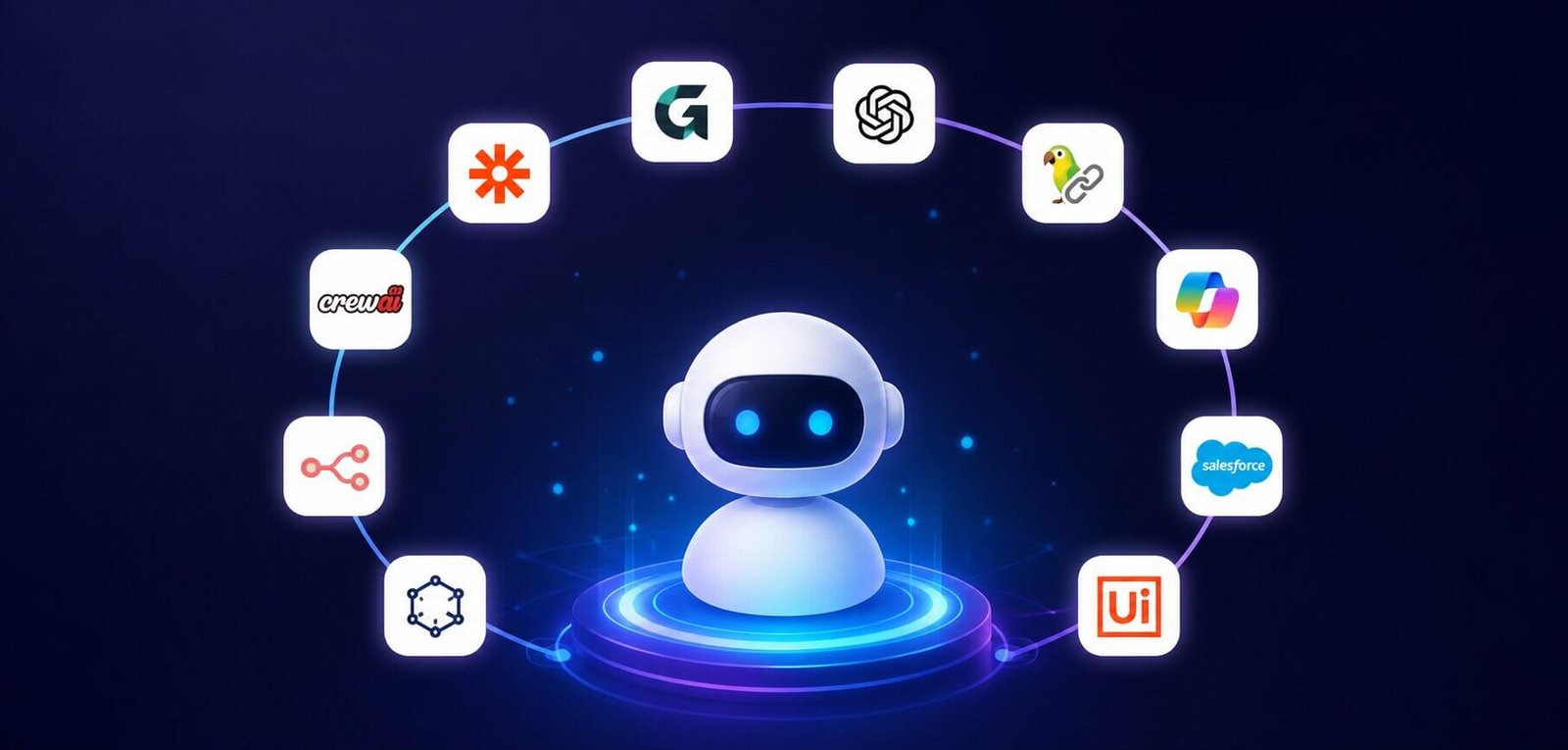
Agentic AI tools have become mainstream in 2026. Unlike simple chatbots, these agents can plan, reason, use tools, adapt, and complete multi-step tasks with minimal human input.
This updated ranking puts free or freemium, popular, and beginner-friendly tools at the top, then moves to more powerful production-grade options. Rankings are based on real user adoption, ease of getting started, autonomy level, and practical results in 2026.
1. CrewAI — Best Overall for Most Users (Free & Popular)
CrewAI remains one of the most popular agentic frameworks in 2026. It lets you create role-based “crews” (e.g., Researcher + Writer + Editor) that collaborate like a team.
Key Strengths:
- Extremely easy to set up and intuitive
- Excellent for content creation, research, marketing, and analysis
- Strong community and fast prototyping
Best For: Beginners, marketers, freelancers, and small teams. Drawbacks: Less robust for very long or highly complex production workflows. Pricing: Completely free (open-source).
2. Gumloop — Best No-Code Agent Builder
Gumloop tops many “practical tools” lists for non-technical users. Describe your goal in natural language, and the agent builds and runs the workflow.
Key Strengths:
- Visual + natural language interface
- Great Slack and app integrations
- Very beginner-friendly
Best For: Freelancers, marketers, and small businesses. Pricing: Generous free plan + paid starts low.
3. Zapier Agents — Best for No-Code Business Automations
Zapier Agents add intelligent decision-making to its massive 7,000+ app ecosystem.
Key Strengths:
- Connects almost any app easily
- Fast time-to-value for real business processes
- No coding required
Best For: Operations, sales, and marketing teams. Pricing: Usage-based on your Zapier plan.
4. n8n — Best Open-Source Low-Code Option
n8n is a powerful, self-hostable automation tool with strong agentic capabilities and 1,000+ integrations.
Key Strengths:
- Full data control and privacy
- Flexible for complex flows
- Cost-effective for serious use
Best For: Privacy-conscious users and developers who want control. Pricing: Free self-hosted version available.
5. Claude (Anthropic) with Projects & Artifacts — Best Reasoning Power
Claude excels at long-context reasoning and complex task handling. Many users combine it with tools for strong agentic behavior.
Key Strengths:
- Superior instruction following and writing quality
- Projects feature helps maintain context
- Excellent for content and analysis workflows
Best For: Content creators and knowledge work. Pricing: Free tier + paid plans.
6. LangGraph (LangChain Ecosystem) — Best for Complex Production Workflows
LangGraph powers serious, stateful, and reliable agent systems with excellent memory, error recovery, and human-in-the-loop features.
Key Strengths:
- Production-grade reliability and observability
- Handles branching, long-running tasks extremely well
Best For: Developers and teams building custom, scalable agents. Drawbacks: Steeper learning curve. Pricing: Open-source core + paid LangSmith for monitoring.
7. Microsoft Copilot Studio — Best for Microsoft Ecosystem Users
Low-code agent builder deeply integrated with Teams, Dynamics 365, and Azure.
Key Strengths:
- Seamless with Microsoft tools
- Strong enterprise security and governance
Best For: Companies already using Microsoft 365. Pricing: Included in Microsoft licenses + consumption.
8. Salesforce Agentforce — Best Enterprise CRM Automation
Native autonomous agents inside Salesforce for sales, service, and marketing.
Key Strengths:
- Deep CRM integration
- High governance and compliance
Best For: Large enterprises on Salesforce. Pricing: Enterprise-level pricing.
9. AutoGen (Microsoft) — Strong for Multi-Agent Conversations
Great for building agents that talk to each other to solve problems collaboratively.
Key Strengths:
- Excellent for research and complex multi-step reasoning
- Good Microsoft integration
Best For: Research-oriented and conversational workflows.
10. UiPath Agentic Automation — Best RPA + AI Hybrid
Combines traditional robotic process automation with modern agentic reasoning.
Key Strengths:
- Handles both structured and unstructured tasks
- Strong in large enterprises with legacy systems
Best For: Operations teams automating repetitive + intelligent processes.
Quick Comparison Table
| Rank | Tool | Best For | Ease of Use | Autonomy Level | Pricing | Score |
|---|---|---|---|---|---|---|
| 1 | CrewAI | Multi-agent teams | Very High | High | Free | 9.2 |
| 2 | Gumloop | No-code users | Very High | High | Free + Paid | 9.0 |
| 3 | Zapier Agents | Business automations | Very High | Medium-High | Usage-based | 8.8 |
| 4 | n8n | Open-source workflows | High | High | Free / Paid | 8.7 |
| 5 | Claude | Reasoning & content | High | High | Free + Paid | 8.6 |
| 6 | LangGraph | Complex production | Medium | Very High | Free / Paid | 9.4 |
| 7 | Copilot Studio | Microsoft users | High | High | License-based | 8.5 |
Key Trends in Agentic AI (2026)
- Multi-agent collaboration delivers better results than single agents.
- No-code/low-code tools (Gumloop, Zapier, n8n) are exploding in popularity.
- Production users still rely on LangGraph for reliability.
- Human oversight remains important for critical tasks.
Which Tool Should You Start With?
- Beginner / Non-technical → CrewAI, Gumloop, or Zapier Agents
- Free & Open-source → CrewAI or n8n
- Already in Microsoft/Salesforce → Use their native agents
- Need maximum control → LangGraph
Pro Tip: Start with one simple workflow (like content research or lead qualification), measure the results, and then expand.